

Not every business fits the risk tolerance of traditional banks or mainstream payment processors. If you’ve been declined for a merchant account or subjected to extra scrutiny, your company may be classified under high-risk payments. But what causes this classification, and what can you do to navigate it effectively?
Whether you operate an e-commerce brand, digital service, or adult wellness business, being labeled “high risk” affects your fees, approval timelines, chargeback limits, and even your access to daily cash flow.
What Determines If a Business Is High Risk?
A combination of factors drives the “high-risk” label. Acquiring banks and payment processors assess your industry risk score, business model, and transactional behavior before approval. Businesses in sectors such as coaching, supplements, or digital content often face higher scores due to higher refund rates, complex compliance requirements, or subscription-based models.
Other considerations include geography, transaction values, sales volume, and product delivery timelines. Even well-managed businesses can be labeled high-risk solely based on industry norms.
How MATCH List Factors Influence Your Status
One of the most significant reputational markers in high-risk payments is inclusion on the MATCH (Member Alert to Control High-Risk Merchants) list—this database, maintained by Mastercard, flags merchants who’ve had issues with prior acquirers.
Common MATCH list factors include fraud, excessive chargebacks, policy violations, or failure to comply with card network rules. Once listed, securing a new processor becomes challenging, often requiring specialised high-risk merchant providers.
Table 1: Common MATCH List Factors That Trigger High-Risk Status
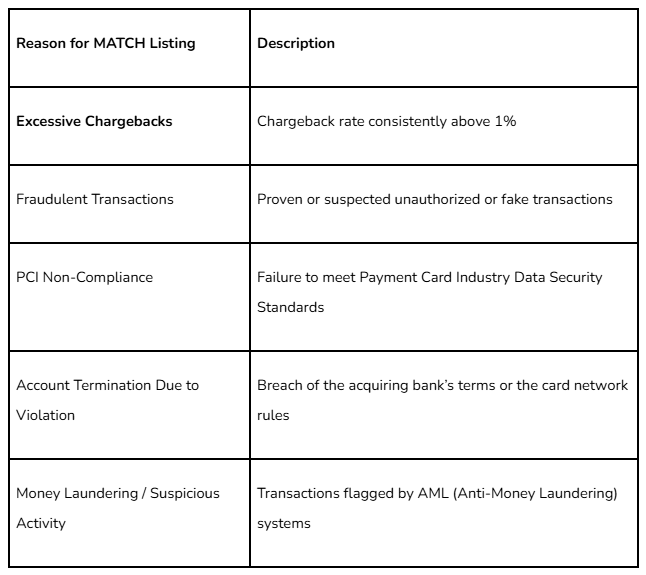
Excessive Chargebacks: The Biggest Red Flag
Another major contributor to high-risk classification is a pattern of excessive chargebacks. When your monthly chargeback ratio exceeds 1%, your account is flagged under Visa and Mastercard’s monitoring programs.
This can lead to increased processing fees, funding holds, and even account termination. Chargebacks, whether due to fraud or customer dissatisfaction, can cripple your payment operations if not managed proactively.
Why Fraud Exposure Matters to Payment Providers
Digital and card-not-present transactions carry inherent risks, especially in high-volume or international businesses. High fraud exposure, including unauthorized transactions, stolen card use, and synthetic identities, signals instability to payment providers.
Implementing fraud filters, 3D Secure, address verification, and transaction monitoring tools is essential. The more robust your fraud prevention systems, the more stable your payment processing environment becomes.
How Visa VAMP Thresholds Impact Merchant Reputation
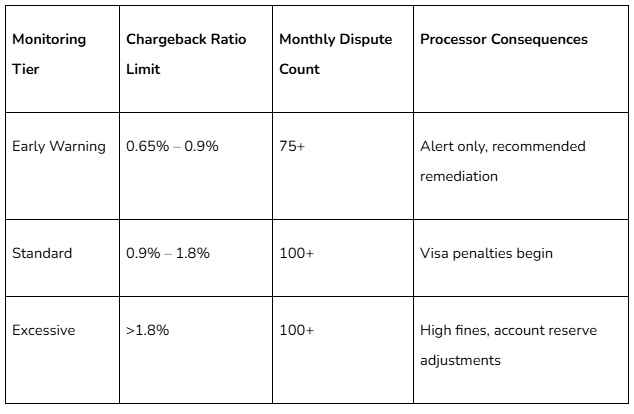
Visa uses the Visa VAMP thresholds (Visa Acquirer Monitoring Program) to track merchant performance based on chargebacks and fraud rates. When merchants exceed these thresholds, Visa may impose fines, increased oversight, or reclassify them as high-risk.
Staying below these limits requires constant monitoring and internal controls. For more guidance on staying compliant, read our in-depth breakdown:
Understanding these benchmarks helps reduce both operational risk and compliance-related penalties.
-
Mastercard VFMP: A Parallel Risk Evaluation System
In addition to Visa’s program, Mastercard enforces its own merchant oversight through the VFMP (Visa Fraud Monitoring Program). Businesses flagged under this system are typically experiencing ongoing fraud issues or repeated dispute patterns.
To avoid VFMP classification, merchants must maintain fraud-to-sale ratios below specific thresholds. This is especially critical in verticals such as nutraceuticals, adult entertainment, or travel. Consistent monitoring, secure checkout flows, and transparent policies are key.
Table 2: Visa VAMP Thresholds Overview
The Visa VAMP Explained below:
-
What Cathedral Offers High-Risk Merchants
Cathedral provides tailored solutions for businesses that traditional processors often turn away. We help companies navigate high-risk payments through custom gateway integrations, fraud prevention strategies, and regulatory compliance tools.
From resolving MATCH list complications to preparing for Visa VAMP thresholds and Mastercard VFMP scrutiny, Cathedral delivers scalable solutions with speed, reliability, and transparency. Our platform is built for industries with elevated risk profiles and that’s who we serve best.
Final Takeaway
Being considered a high-risk merchant doesn’t mean your business is untrustworthy, and it simply means your model requires advanced support. By addressing MATCH list factors, reducing excessive chargebacks, managing industry risk score, and minimizing fraud exposure, you can strengthen your processing relationships.
If you’re concerned about Visa VAMP thresholds or have been flagged under Mastercard VFMP, now is the time to act. Cathedral specializes in empowering high-risk businesses with secure, compliant, and performance-focused solutions.