

In today’s digital-first world, understanding what a payment gateway is and how it works can transform your online business. You’ve likely heard terms like payment of gateway, payment gateway integration, gateway account, and credit card gateway—but what do they truly mean, and why should they matter to you? In this guide, I’ll walk you through every facet of payment gateways, from fundamental definitions to the nuts and bolts of transaction flows, security measures, and integration strategies. By the end, you’ll know how to choose and implement the right solution for your unique needs.
Why Payment Gateways Matter for Your Business
Every time a customer clicks “Buy Now,” a series of behind-the-scenes processes must occur securely and seamlessly. A payment gateway acts as the digital equivalent of a point-of-sale terminal in a brick-and-mortar store. Without it, you’d struggle to:
- Authorize credit card transactions
- Protect sensitive data with encryption and tokenization
- Settle and reconcile funds into your merchant account
Understanding the mechanics of a payment gateway integration empowers you to optimize checkout flows, reduce cart abandonment, and boost conversion rates.
Core Components of Payment Gateways
Payment Gateway Integration
When you explore payment options, you’ll encounter the phrase payment gateway integration. This refers to how your website or app connects to the gateway’s API or SDK. A robust integration lets you:
- Initiate payment requests dynamically
- Handle callbacks and webhooks for transaction status
- Customize the checkout experience without redirecting customers
By mastering integration best practices, you ensure data flows securely between your platform and the payment processor.
Gateway Account Explained
A gateway account (often called a merchant account) is where funds are held temporarily after a transaction is approved. Think of it as a holding pen before money moves into your primary business bank account. Key considerations include:
- Settlement periods—how long funds remain in the gateway account
- Dispute management—handling chargebacks and refunds
- Fee structures—monthly fees, per-transaction charges, and setup costs
Understanding your gateway account terms helps you forecast cash flow and manage operational budgets.
Credit Card Gateway Deep Dive
A credit card gateway specializes in processing card-based payments. Whether your customers use Visa, MasterCard, American Express, or Discover, this gateway must:
- Validate card details through the issuing bank
- Enforce 3D Secure or CVV checks
- Handle recurring billing securely for subscriptions
A reliable credit card gateway will boost trust by displaying PCI-DSS compliance badges and offering tokenization to securely store card references.
How Does a Payment Gateway Work?
Transaction Flow: Authorization, Capture, Settlement
Behind the scenes of every online purchase, three main steps occur:
- Authorization: The gateway sends the customer’s card data to the issuing bank for approval.
- Capture: Once authorized, the funds are earmarked but not yet transferred.
- Settlement: The issuing bank transfers the captured funds into your gateway account, which are then moved into your business bank account.
Each step happens in seconds, but optimizing for speed and reliability is crucial to prevent timeouts and errors at checkout.
Security Measures: Encryption, PCI-DSS, Tokenization
Protecting sensitive financial data is non-negotiable. Robust gateways employ:
- End-to-end encryption: Data is encrypted from the moment it leaves your website until it reaches the processor.
- PCI-DSS compliance: Adhering to Payment Card Industry standards demonstrates rigorous security.
- Tokenization: Card details are replaced with tokens, so your servers never store raw card numbers.
When your gateway checks all these boxes, you safeguard both your customers and your reputation.
Types of Payment Gateways
Every business has distinct requirements—whether it’s dealing with specialized industries or embracing new payment methods. Let’s explore four major categories.
Hosted vs. Integrated Payment Gateways
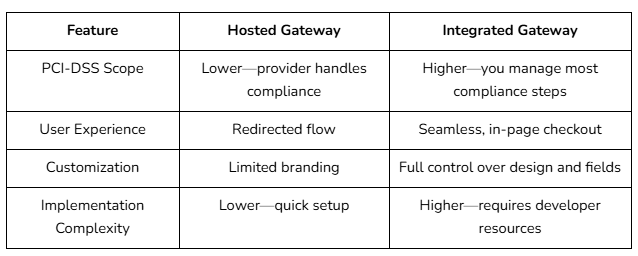
With a Hosted vs. Integrated Payment Gateways decision, you weigh simplicity against control. A hosted gateway redirects users to a secure hosted page, offloading PCI compliance. An integrated gateway keeps transactions on your site, offering full customization but requiring stricter security measures.
High-Risk Industries
If your business operates in sectors like online gaming, travel, or adult entertainment, you may need high-risk payment solutions. These gateways specialize in higher-chargeback environments and offer tailored risk assessments, ensuring you maintain robust authorization rates.
Cryptocurrency Gateways
For a modern edge, you might integrate Crypto Payments. These gateways allow customers to pay with Bitcoin, Ethereum, and stablecoins. Benefits include near-instant settlement and access to a global audience. However, you must manage crypto-fiat conversion and adhere to evolving regulatory guidelines.
Mobile Wallets & Alternative Methods
Beyond cards and crypto, consider digital wallets such as Apple Pay, Google Pay, and regional solutions like Alipay. Offering a variety of methods increases overall conversions, especially in markets where mobile payments dominate.
Selecting the Right Payment Gateway for Your Needs
Choosing the optimal gateway means matching features to your business goals and customer demographics.
Key Considerations
- Fee Structure: Look for transparent pricing—setup fees, monthly minimums, transaction rates, and chargeback fees.
- Global Reach: Does the gateway support multi-currency and local payment methods?
- Developer Resources: Comprehensive API documentation, SDKs, and sandbox environments.
- Uptime & Latency: Seek SLAs guaranteeing high availability and low transaction times.
Evaluating Payment of Gateway Options
You’ll often see “payment of gateway” misstated, but what matters is thorough due diligence. Test multiple gateways using pilot programs, measure conversion lift, and survey customer feedback on checkout ease.
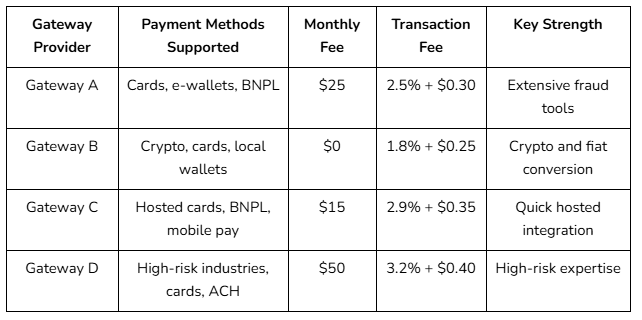
Leading Gateway Features
Future Trends in Payment Gateways
Staying ahead means embracing innovations:
- AI-Driven Fraud Prevention: Machine learning models analyze behavioral patterns in real time to reduce false declines.
- Biometric Authentication: Facial recognition and fingerprint payments simplify logins and thwart fraud.
- Blockchain-Based Settlement: Beyond crypto, blockchain can speed up cross-border settlements with reduced costs.
- Embedded Finance: Brands will integrate lending, insurance, and banking features directly into the checkout experience.
By monitoring these trends, you ensure your payment strategy remains competitive and customer-centric.
Conclusion:
Implementing the right gateway—from credit card gateway solutions to seamless payment gateway integration—can dramatically impact your bottom line. Whether you need a high-risk specialist, a crypto-friendly provider, or a robust Payment Gateways suite, choose a partner who understands your business model, security requirements, and growth trajectory. At Cathedral, we provide expert gateway accounts and end-to-end integration services that empower you to offer frictionless, secure payments at scale.
Frequently Asked Questions
What is the difference between a payment gateway and a merchant account?
A payment gateway is technology that authorizes and encrypts transactions, while a merchant account is the holding account where funds are settled before reaching your bank.
How long does payment settlement take?
Typical settlement periods range from the same day to 3–5 business days, depending on your gateway account terms and banking partners.
Can I switch gateways without disrupting my customers?
Yes. By using a modular integration and feature-flagged rollout, you can migrate gateways with minimal downtime and customer impact.
Are hosted gateways less secure than integrated gateways?
Hosted gateways reduce your PCI-DSS scope because the provider handles most of the security burden. Integrated gateways can be equally secure if you follow best-practice encryption and compliance processes.
How do cryptocurrency gateways handle volatility?
Most crypto gateways provide instant conversion to fiat at the point of transaction, locking in exchange rates and shielding you from price swings.